Disclosure: This post contains affiliate links. If you purchase through our links, we may earn a small commission at no extra cost to you. We only recommend products we believe in. Full disclaimer here.
⚕️ Medical Disclaimer: The information on this page is for educational purposes only and is not a substitute for professional medical advice. Always consult a qualified healthcare provider before starting any hair loss treatment, supplement, or device. Individual results may vary.
Premium scalp serums for thinning hair run from $24 to $125 — and not, it turns out, for the same amount of liquid. The expensive ones talk about patented complexes, biotech actives and clinical backing. The cheap ones often list the same trademarked ingredients on the back of the bottle.
So we did the obvious thing that almost no buying guide does: we pulled the full ingredient list for six of the most widely sold scalp serums, put them side by side in concentration order, and looked at what you actually get for the money.
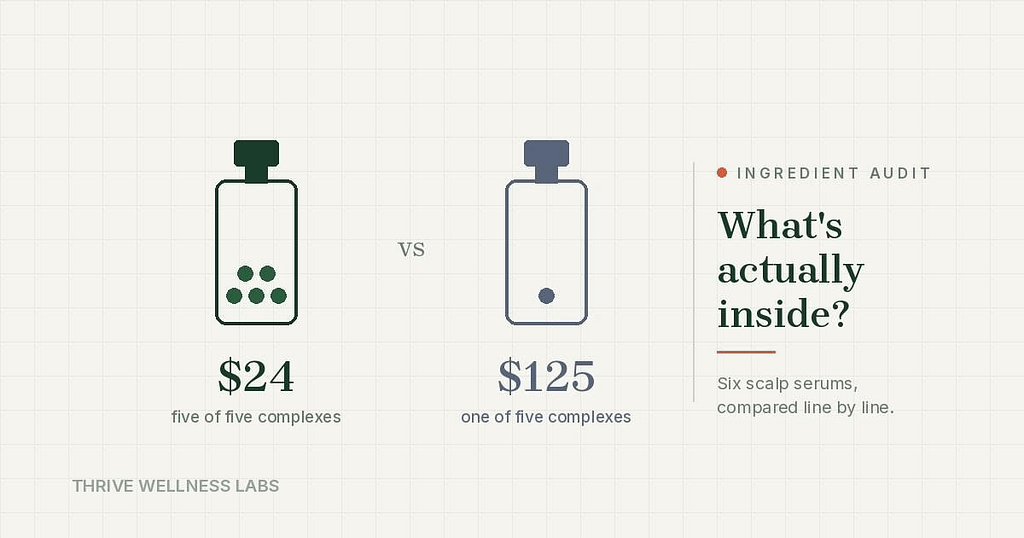
The short version is that price and formulation have very little to do with each other in this category. The $24 serum carries the ingredients behind more of the industry’s headline complexes than the $125 one does.
THE SHORT VERSION
We read the full ingredient list for six scalp serums. The $24 one carries the ingredients behind all five of the complexes the industry markets on. The $125 one carries the ingredients of one. The $113 one carries none. Price tells you almost nothing about what’s in the bottle.
Best formulation for the money — The Ordinary Multi-Peptide Serum, $24. All five complexes, the only product disclosing its actives concentration (21.15%), fragrance-free, and the cheapest per millilitre.
If you want a premium option — Obagi Nu-Cil, $125. Fewer complexes, but fragrance-free with a broad botanical profile. You’re paying for the brand and the botanicals, not for more of the headline technology.
This is an ingredient comparison, not an efficacy test — we can tell you what you’re paying for, not what will work. Check the cost per millilitre before buying: bottles here range from 30ml to 100ml, and the $64 VEGAMOUR costs more per millilitre than the $125 Obagi.
📋 What this article is — and isn’t
This is an ingredient comparison. We read the published INCI lists — the legally required ingredient declarations, which run in descending order of concentration — and compared what’s in each bottle against what the marketing claims.
It is not an efficacy test. We have not used these products, we have not run trials, and we cannot tell you which one will regrow your hair. Nobody has compared these six products head-to-head in a controlled study. What we can tell you is what you’re paying for, which is a different and more answerable question.
All products discussed here are cosmetics, not pharmaceuticals. None is approved to diagnose, treat, cure or prevent any medical condition, and where we mention published research, that research concerns individual ingredients rather than these finished products.
📖 Read this if you:
- Are looking at hair density serums and can’t work out why they range from $24 to $125
- Want to know whether “patented complex” means anything or is just packaging
- Have a sensitive or irritated scalp and need to know which products contain fragrance
- Are already using microneedling or a laser cap and wondering whether to add a topical
📋 Table of Contents
How We Compared These Scalp Serums
Every claim in this article can be checked. Here’s exactly what we did and where the data came from.
🔬 Our methodology
- What we included: leave-on scalp serums marketed for hair density, thinning or shedding. We excluded bond-repair, smoothing and styling products, which are about hair appearance rather than the follicle.
- On ratings: we didn’t apply a star-rating cutoff. Amazon ratings on this category reflect a lot of things other than formulation — delivery, packaging, and the fact that hair loss products disappoint people for reasons no serum could fix. We’ve noted each product’s rating and review volume where it’s useful context, but we didn’t let it decide what got included.
- Ingredient sources: full INCI declarations in descending concentration order, taken from independent ingredient databases — principally IncideCoder and Skinsort — rather than brand marketing copy. These are secondary sources compiling published declarations, not manufacturer records, and we cross-checked against brand and retailer listings where those were available. Where two sources disagreed, we noted it rather than picking one.
- What we looked for: presence and position of the trademarked complexes the industry markets on; concentration disclosure; caffeine; fragrance allergens; and how far actives sit from the thickeners and preservatives at the end of the list.
- How to read ingredient positions: Under standard INCI labelling conventions, ingredients above 1% are listed in descending order of concentration, while those at or below 1% may appear in any order at the end. So a high position means a lot of something; a position in the tail means under 1%, but the exact ranking down there tells you little.
- Prices: checked on Amazon US on 16 August 2026, on the specific ASIN and size variant each of our links points to. Prices in this category move constantly — treat ours as indicative and check the current figure before buying.
- What we didn’t do: test the products, measure hair density, or accept free samples or payment from any brand for inclusion.
💡 On our affiliate links
Worth stating plainly: when we checked, all six of these products were assigned the same commission rate in our Amazon account. We have no financial reason to push you toward the expensive ones, which is convenient, because the ingredient lists don’t support doing so.
The Trademarked Complexes, Explained Honestly
Five branded ingredient technologies dominate this category. You’ll see them capitalised and trademarked on packaging as though they were pharmaceuticals. Here’s what they are and — more importantly — where their evidence comes from.
| Complex | What’s actually in it | Who owns it |
|---|---|---|
| REDENSYL | Larix europaea wood extract, Camellia sinensis leaf extract, glycine, zinc chloride | Givaudan |
| Procapil | Biotinoyl tripeptide-1, apigenin, oleanolic acid | Sederma |
| CAPIXYL | Acetyl tetrapeptide-3, red clover (Trifolium pratense) extract | Lucas Meyer Cosmetics |
| BAICAPIL | Scutellaria baicalensis root, wheat germ, soy germ extracts | Provital |
| AnaGain | Pea (Pisum sativum) sprout extract | Mibelle Biochemistry |
Notice the right-hand column. Every one of these is owned by a company that sells the ingredient to cosmetics manufacturers. And essentially all the published efficacy data for them comes from those same companies.
One caveat that runs through the rest of this article: an ingredient list tells you which components are present, not whether a brand bought the finished trademarked blend or simply included the same botanicals separately. Where we say a product “carries” a complex, we mean its constituent ingredients appear on the label — nothing more.
🧭 Four different numbers for the same ingredient
While researching this article, we found these figures for REDENSYL’s effect on hair density, each stated confidently by a different review site:
- 17% increase in 84 days
- 34% increase in 84 days
- 8–10% increase in 90 days
- 12% increase in 12 weeks
Same ingredient, four incompatible claims. They all ultimately trace back to manufacturer-supplied material. The independent ingredient database IncideCoder makes the same point about CAPIXYL: the only results available come from the manufacturer, so the claims warrant caution until someone else replicates them.
None of this means the complexes don’t work. It means nobody outside the companies selling them has demonstrated that they do, and that is a meaningfully different situation from the one the packaging implies.
Side by Side: What’s Actually in the Bottle
This is the table the rest of the article rests on. A tick means the ingredients that make up that complex appear in the published list. It does not confirm the branded blend is present as the supplier sells it, and it says nothing about how much. Only one of these six products tells you how much of anything is in it. The fragrance column is included here rather than buried below, because for a leave-on scalp product it may matter more than any of the complexes.
| Serum | Price | Size | Cost / ml | REDENSYL | Procapil | CAPIXYL | BAICAPIL | AnaGain | Caffeine | Fragrance / irritants | Conc. disclosed |
|---|---|---|---|---|---|---|---|---|---|---|---|
| The Ordinary Multi-Peptide | $24 | 60ml | $0.40 | ✓ | ✓ | ✓ | ✓ | ✓ | 5th | none | 21.15% |
| Nutrafol Scalp Serum | $69 | 50ml | $1.38 | ✓ | — | — | — | ✓ | none | tea tree | no |
| Obagi Nu-Cil BioStim | $125 | 60ml | $2.08 | — | ✓ | — | — | — | 6th | none | no |
| VEGAMOUR GRO | $64 | 30ml | $2.13 | — | — | part* | — | — | 5th | 4 + alcohol | no |
| Redken Acidic Grow Full | $46 | 100ml | $0.46 | — | — | — | — | — | 4th | 8 allergens | no |
| Monpure Follicle Boost | $113 | 50ml | $2.26 | — | — | — | — | — | 13th† | 4 allergens | no |
*VEGAMOUR contains red clover and mung bean sprout extract, which overlaps with CAPIXYL’s botanical component but not its peptide. †As Coffea arabica seed extract rather than isolated caffeine.
The $24 vs $125 Problem
Read the table from the top and two patterns are hard to miss.
The Ordinary Multi-Peptide Serum costs $24 and its ingredient list carries the components of all five complexes. Those components sit between the fifth and twentieth positions — ahead of the thickeners, gums and preservatives that make up the back half. It is also the only product of the six to publish a total actives figure: the brand states 21.15% by weight.
The Obagi Nu-Cil BioStim Scalp Serum costs $125 and carries the components of one. Apigenin, oleanolic acid and biotinoyl tripeptide-1 appear at positions ten, eleven and twelve — those three are what Procapil is made of. There is no REDENSYL, no CAPIXYL, no BAICAPIL and no AnaGain.
Monpure’s Follicle Boost Hair Density Serum costs $113 and contains none of them at all. Its highest-positioned active is retinyl palmitate — a vitamin A ester — at fifth.
And the shelf price hides something too
Bottle sizes in this category range from 30ml to 100ml, which means the number on the shelf tells you less than it appears to. Work it out per millilitre and the ranking shifts:
VEGAMOUR GRO costs $64 and Obagi costs $125 — but per millilitre, the VEGAMOUR is the more expensive of the two. It’s a 30ml bottle against Obagi’s 60ml. On the shelf it looks like the mid-range option. Per millilitre it is the dearest here.
The same arithmetic works in Redken’s favour. At $46 it looks like a step up from The Ordinary, but its 100ml bottle works out at $0.46/ml against The Ordinary’s $0.40 — practically the same. What separates them isn’t cost, it’s what’s in them, and what else is in them.
The honest interpretation: in this category, neither the shelf price nor the price per millilitre predicts how much of the industry’s own headline technology you’re buying. That is a statement about formulation and cost, not about results — but it is the statement the marketing is most designed to prevent you from making.
📊 Trademarked complexes, by price
Number of the five industry-standard complexes present in each formulation.
5
2
1
0
Presence is not potency. Only The Ordinary discloses how much active material its formula contains, so a product with fewer complexes at higher concentrations could in principle outperform one with more at trace levels. But nobody publishing these formulas is giving you the information you’d need to judge that.
The honest interpretation: in this category, price does not predict how much of the industry’s own headline technology you’re buying. That is a statement about formulation and cost, not about results — but it is the statement the marketing is most designed to prevent you from making.
Which Ingredients Have Independent Evidence?
If the trademarked complexes rest on supplier-funded data, what in these bottles has been studied by someone with no commercial interest in the answer?
Two things, and both are worth knowing about.
Caffeine
Topical caffeine has been investigated independently for hair loss, and laboratory work offers a plausible follicle-level mechanism involving dihydrotestosterone. It is the better-studied active in this comparison and — unlike the branded complexes — it isn’t owned by anyone with a commercial interest in the results. How much of it reaches the follicle from any given finished formula is a separate question the research doesn’t answer.
It also appears in five of the six serums here. The highest position — fourth — belongs to the $46 Redken, though as we’ll come to, that formula carries a good deal else besides. The $24 Ordinary has it at fifth. If you were buying purely for the ingredient with the strongest independent support, price would not guide you toward the expensive end of this shelf.
Melatonin
Only one product here contains melatonin: the Nutrafol serum, at twentieth position. Topical melatonin has appeared in independent hair loss research, which is more than can be said for most of the botanicals in this comparison. But it sits in the below-1% portion of that formula, and nothing in the ingredient list tells you whether the amount present would do anything.
⚠️ A note on what “clinically proven” means here
Several of these products use language like “clinically tested” or cite percentage improvements. In almost every case, the study in question was conducted or commissioned by the company selling the ingredient or the product. That is not fraud — it is how the cosmetics industry generates data — but it is not the same as independent verification, and the packaging never makes the distinction.
The Fragrance Problem Nobody Mentions
This is the finding we didn’t expect, and it may matter more day-to-day than the complexes do.
A scalp serum is a leave-on product. You apply it daily and don’t wash it off. If your hair loss involves any inflammatory component — and a good deal of pattern thinning does — then what you’re leaving on the scalp is worth thinking about.
Three of these six contain declared fragrance allergens — substances flagged on the label because sensitisation has been documented above certain thresholds. Most people react to none of them:
| Serum | Fragrance status |
|---|---|
| Redken Acidic Grow Full | Parfum plus eight declared allergens: limonene, linalool, citral, linalyl acetate, carvone, pinene, lemon peel oil, bergamot peel oil |
| Monpure Follicle Boost | Citral, geraniol, limonene, linalool, plus rosemary and lemongrass oils |
| VEGAMOUR GRO | Limonene, linalool, citral, bergamot peel oil |
| Nutrafol Scalp Serum | No parfum, but contains tea tree oil — a contact allergen for some people |
| Obagi Nu-Cil | Fragrance-free |
| The Ordinary Multi-Peptide | Fragrance-free |
Declared allergens on a European ingredient list mean the substance is present above a threshold at which sensitisation has been documented. Most people will have no reaction whatsoever. But if you have a sensitive scalp, eczema, or you’re already using microneedling or a retinoid on the same skin, the two fragrance-free options are the sensible starting point — and they happen to be the cheapest and the most expensive on the list.
One more worth flagging: VEGAMOUR’s third ingredient is denatured alcohol, ahead of the caffeine. On a daily leave-on scalp product, that’s a drying agent higher up the list than any of the actives.
The Six Scalp Serums in Detail
Ranked by what the ingredient lists show, not by price.
1. The Ordinary Multi-Peptide Serum for Hair Density ⭐ Most Actives Per Dollar
Price: $24.00 for 60ml — $0.40/ml | Complexes: all five
Caffeine: 5th position, 1% stated | Fragrance: none
Disclosure: full INCI plus 21.15% total actives
This is the only product here that publishes a total actives figure, and its ingredient list carries the components of every complex the category markets on. Those components appear between the fifth and twentieth positions; the back half is thickeners, solubilisers and preservatives, as you’d expect.
What that buys in terms of results, nobody can honestly say. What it buys is a formula carrying more of the industry’s own headline ingredients than any other product here, at the lowest price on the shelf and per millilitre.
✅ Pros
- Carries the components of all five tracked complexes
- Only product disclosing total actives concentration
- Fragrance-free
- Cheapest by a wide margin
❌ Cons
- The complexes’ evidence is still supplier-funded
- Contains lactic acid — may sting broken skin
- No independent trials of this finished formula
🛒 View Today’s Price on Amazon →
2. Nutrafol Hair Growth Scalp Serum 🔬 Only One With Melatonin
Price: $69.00 for 50ml — $1.38/ml | Complexes: REDENSYL, AnaGain
Caffeine: none | Fragrance: no parfum, contains tea tree oil
Note on which version to buy: Nutrafol sells this serum in separate formulations rather than a single unisex product. The ingredient analysis below is based on the women’s formula. Check the listing matches your situation before ordering — and if you’re comparing the men’s version, the ingredient list may differ from what we examined.
The components of two complexes, positioned high — Camellia sinensis at third, glycine at fourth, Larix europaea at fifth and pea sprout at sixth. Those are the ingredients behind REDENSYL and AnaGain, sitting near the front of the formula rather than buried at the end.
It’s also the only serum here containing melatonin, one of the two ingredients in this comparison that has been studied outside the supplier network. At twentieth position it sits in the below-1% portion, and the label tells you nothing more than that.
The notable absence is caffeine, which every other product includes.
✅ Pros
- Two complexes, both high in the list
- Only product containing melatonin
- No added parfum
- Pairs with their supplement range if you already use it
❌ Cons
- Tea tree oil — contact allergen for some users
- No caffeine
- Nearly four times the price of The Ordinary
- No concentration disclosure
🛒 View Today’s Price on Amazon →
3. Obagi Nu-Cil BioStim Scalp Serum 🌿 Fragrance-Free
Price: $125.00 for 60ml — $2.08/ml | Complexes: Procapil only
Caffeine: 6th position | Fragrance: none
The most expensive serum in the comparison. Its price is not explained by the number of branded complexes it carries. Procapil is present — apigenin, oleanolic acid and biotinoyl tripeptide-1 at positions ten to twelve — but none of the other four complexes appear.
What it has instead is a long tail of botanicals and amino acids: pumpkin seed extract, Panax ginseng, burdock root, hydrolysed soy protein, arginine, citrulline, ornithine. Pumpkin seed extract has some supporting research in hair loss, though the notable trial used an oral supplement rather than a topical.
One thing worth noting given the product name: biotin appears at position twenty-nine of thirty-one, immediately before the preservatives. We confirmed this across two independent ingredient databases.
There’s a labelling nuance that makes this more damning rather than less. Under standard INCI labelling conventions, ingredients above 1% are listed in descending order of concentration, but everything at or below 1% may be listed in any order. So biotin’s exact position among the last few ingredients doesn’t tell us much — but its presence in that bottom cluster places it in the below-1% portion of the formula. The exact amount can’t be established from the ingredient list. What can be said is that a product named for biotin doesn’t lead with it.
It is fragrance-free, which counts for something if your scalp is reactive.
✅ Pros
- Fragrance-free
- Caffeine high in the formula
- Broad botanical and amino acid profile
- Established medical-aesthetics brand
❌ Cons
- One complex, at seven times the price of a serum with five
- Biotin near the bottom despite the product name
- No concentration disclosure
- Botanicals sit below the emulsifiers in the list
🛒 View Today’s Price on Amazon →
4. Redken Acidic Grow Full Scalp & Hair Serum ☕ Highest Caffeine Position
Price: $46.00 for 100ml — $0.46/ml | Complexes: none
Caffeine: 4th position — highest here | Fragrance: parfum + 8 allergens
No trademarked complexes at all. What it does have is caffeine at fourth position, higher than in any other serum in this comparison, plus azelaic acid.
It’s also better value than the shelf price suggests. The 100ml bottle is the largest here, and at $0.46/ml it costs almost exactly what The Ordinary does — despite looking like nearly twice the price on the shelf.
The consideration is everything else. Parfum plus eight declared fragrance-related ingredients on a leave-on scalp product is the heaviest fragrance load in this group by a distance. Most people won’t react. But if you’re sensitive to fragrance, that’s the deciding factor here, and no amount of caffeine positioning offsets it.
It’s also worth noting that L’Oréal’s own ingredient tool displays this formula alphabetically with several entries omitted. We used a third-party database that publishes it in concentration order instead.
✅ Pros
- Caffeine at 4th — highest position here
- Largest bottle: 100ml at $0.46/ml
- Contains azelaic acid
- Best value per ml after The Ordinary
- Widely available salon brand
❌ Cons
- Eight declared fragrance allergens
- No trademarked complexes
- Manufacturer’s own listing is alphabetical and partial
- Marketed on “thicker-looking” — an appearance claim
🛒 View Today’s Price on Amazon →
5. VEGAMOUR GRO Hair Serum
Price: $64.00 for 30ml — $2.13/ml | Complexes: partial CAPIXYL botanicals
Caffeine: 5th position | Fragrance: limonene, linalool, citral, bergamot
Caffeine at fifth and turmeric callus culture at sixth, with red clover and mung bean sprout at eleventh and twelfth. The clover overlaps with CAPIXYL’s botanical half, though not its peptide.
The bottle is the smallest here at 30ml, which makes this the most expensive serum in the comparison per millilitre — $2.13/ml, ahead of the $125 Obagi’s $2.08. The shelf price of $64 puts it in the middle of the group. The price per millilitre does not.
Two things give us further pause. Denatured alcohol sits at third position — ahead of every active — on a product designed to be left on the scalp daily. And oligopeptide-2, one of the ingredients the marketing leads with, appears last on the list of twenty. Neither observation means the product will irritate everyone — but if you have a dry or reactive scalp, a leave-on formula with denatured alcohol that high is worth pausing over.
The turmeric stem cell technology is the brand’s signature claim. We could not find independent research supporting it for hair density.
✅ Pros
- Caffeine high in the formula
- Red clover present
- Vegan and cruelty-free
- Large user base and review volume
❌ Cons
- Denatured alcohol at 3rd position
- Headline peptide is the last ingredient listed
- Most expensive per ml of the six
- Four fragrance allergens
- Signature ingredient lacks independent research
🛒 View Today’s Price on Amazon →
6. Monpure Follicle Boost Hair Density Serum
Price: $113.00 for 50ml — $2.26/ml | Complexes: none
Caffeine: 13th, as coffee seed extract | Fragrance: citral, geraniol, limonene, linalool
The second most expensive serum here and the one with the least of what the category markets on. No trademarked complexes. Its most prominent active is retinyl palmitate — vitamin A — at fifth position.
That’s an unusual choice for a scalp product and it isn’t flagged prominently on the listing. Retinyl palmitate is a vitamin A ester, generally considered the mildest of the retinoid family and much weaker than a prescription retinoid. Vitamin A derivatives can still cause irritation and raise sun-sensitivity concerns depending on the formulation, which is worth knowing if you have thinning areas that catch the sun. Follow the label, and don’t apply it onto freshly microneedled skin.
Pumpkin seed extract, argan and grapeseed oils, vitamins C and E and rosemary oil fill out the formula. Rosemary oil has its own body of research in hair loss — we’ve covered it separately — but here it sits at fifteenth, below several carrier oils.
✅ Pros
- Contains a retinoid (retinyl palmitate) — unusual here
- Pumpkin seed extract present
- Witch hazel base may suit oily scalps
- Includes rosemary oil
❌ Cons
- No trademarked complexes at $113
- Retinoid not clearly flagged — photosensitivity risk
- Four fragrance allergens
- Caffeine only as a botanical extract, low in the list
🛒 View Today’s Price on Amazon →
How to Choose
If you want the most of the industry’s headline actives per dollar
The Ordinary. It carries the components of all five complexes, publishes a total actives figure, is fragrance-free, and is the cheapest both on the shelf and per millilitre.
If you’re checking value rather than shelf price
Work out the cost per millilitre before you buy. Bottles here range from 30ml to 100ml, and the $64 VEGAMOUR costs more per millilitre than the $125 Obagi.
If your scalp is sensitive or already being treated
The Ordinary or Obagi — the only two fragrance-free options. Note that if you also microneedle, you should not apply any cosmetic serum onto freshly needled skin; see the FAQ below.
If you’re prioritising independently researched ingredients
Caffeine is the better-studied candidate, and Redken has it highest — but weigh that against eight fragrance allergens. The Ordinary has caffeine at fifth with no fragrance at all.
If you’re deciding whether to buy a serum at all
Minoxidil has decades of independent evidence and costs less than most of these. If you haven’t tried it, that’s the more evidence-backed starting point — see our comparison. Serums are best thought of as an addition, not a replacement.
Frequently Asked Questions
Do hair density serums actually work?
We can’t answer that from ingredient lists, and neither can anyone else selling them. What we can say is that the branded complexes these products are built on have their efficacy data supplied by the companies that own the ingredients, and that independent replication is largely absent. Caffeine and melatonin have better independent support than the rest.
Is a $125 serum better than a $24 one?
Not in terms of the branded ingredients it carries — the $24 option here has the components of all five complexes and the $125 option has one. Whether that translates into a difference you’d notice on your scalp is a separate question that nobody has answered with independent evidence.
Why does concentration matter so much?
Because ingredient lists tell you the order, not the amount. A product can list an impressive active that’s present at 0.01%. Only one product in this comparison publishes a total actives figure, which makes genuine comparison across the category close to impossible.
Can I use a serum with minoxidil?
These are cosmetic products rather than drugs, and many people layer them. Apply them at different times of day rather than together. Speak to a doctor if you’re on any prescribed topical.
Can I use a serum straight after microneedling?
No — and this is worth being clear about. Microneedling creates temporary channels through the skin barrier. None of the serums here are sterile, and several contain fragrance allergens, essential oils, preservatives and penetration enhancers. Applying them onto freshly needled skin substantially increases the risk of contact dermatitis and sensitisation to ingredients you might otherwise tolerate fine.
If you use both, leave a clear gap and favour the fragrance-free options. How long a gap depends on needle depth, how your skin responds, and the protocol you’re following — check your device’s instructions or ask a clinician rather than working to a fixed number. Minoxidil is a different case: it’s a regulated drug product, though combining it with microneedling should still follow clinical guidance. Cosmetic serums have no comparable protocol behind them at all.
What does “thicker-looking hair” actually mean?
It’s a cosmetic appearance claim, not a regrowth claim, and the wording is chosen carefully. A product can make hair look fuller by coating the shaft without doing anything to the follicle. Where a label says “looking,” read it literally.
Are fragrance allergens dangerous?
For most people, no. They’re declared because sensitisation has been documented above certain thresholds, not because they’re harmful to everyone. But on a leave-on scalp product used daily, on skin you may already be treating, avoiding them is the lower-risk choice if you have the option.
The Bottom Line
We set out to find whether expensive scalp serums carry more of what the category claims to sell. Across six products from $24 to $125, they don’t. The cheapest serum here carries the components of all five branded complexes and is the only one publishing a total actives figure. The two most expensive carry one and none respectively.
That is a finding about formulation and price, not about results. We haven’t tested these products and we can’t tell you what any of them will do for your hair.
What we can tell you is that in this category, the price on the box is not information about what’s inside it — and that the ingredient with the best independent evidence behind it, caffeine, is in almost all of them regardless of what you pay.
Using one of these serums, or considering one? Leave a comment below — we read and respond to every one.
Related reads:
→ Derma Roller for Hair Growth: Does It Actually Work? (2026 Guide)
→ Laser Caps for Hair Growth: Do They Actually Work? (2026 Evidence Review)
→ Top 5 Hair Growth Supplements on Amazon That Actually Work (2026)
Medical Disclaimer: Thrive Wellness Labs provides health and wellness information for educational purposes only. It is not a substitute for professional medical advice, diagnosis, or treatment. Always seek the advice of your physician or other qualified health provider with any questions you may have regarding a medical condition, supplement, or treatment device.
FDA Disclosure: These statements have not been evaluated by the Food and Drug Administration. The products reviewed on this site are not intended to diagnose, treat, cure, or prevent any disease.