Disclosure: This post contains affiliate links. If you purchase through our links, we may earn a small commission at no extra cost to you. We only recommend products we believe in. Full disclaimer here.
⚕️ Medical Disclaimer: The information on this page is for educational purposes only and is not a substitute for professional medical advice. Always consult a qualified healthcare provider before starting any hair loss treatment, supplement, or device. Individual results may vary.
You noticed it in a photograph, or under the bathroom light, or when your ponytail felt thinner in your hand. The part looks wider than it used to.
Female pattern hair loss works differently from the male version. It rarely creeps back from the forehead. It thins across the top and crown, gradually, which means it’s often well underway before it becomes obvious.
This is a guide to female pattern hair loss treatment: what the evidence actually supports, what to skip, and — first — the situations where the answer isn’t a product at all.
Some links below are affiliate links. We earn a commission if you buy through them, at no extra cost to you. Product choices were made from the evidence review below, not from commission rates.
The Short Version
- Pattern hair loss is thinning, not shedding — though the two can happen together. Hair regrows finer each cycle until there’s visibly less of it.
- Topical minoxidil is the only treatment with substantial evidence in women. The 2% and 5% strengths performed similarly in pooled trials.
- Price and effectiveness are barely related here. The best-evidenced option costs around $30. Several $80+ products have far weaker evidence behind them.
- Treatment holds ground more often than it regrows. Stable photographs after a year are a good result for a progressive condition.
- Some situations need a doctor, not a purchase — a receding hairline, thinning eyebrows, patchy loss, or a scalp that hurts.
- Minoxidil is dangerous to cats. If you have one, read the safety box below before you buy anything.
Read this if you
- Noticed your part widening over the past year or two
- Are shedding heavily after a birth, an illness, or a period of undereating
- Have tried supplements for months with nothing to show for it
- Were told “it’s genetic” and left without a plan
Before you buy anything: four things to check
Most hair thinning in women is pattern hair loss, and it isn’t urgent. A few conditions look similar, are permanent, and get worse while you wait.
See a doctor before buying anything if:
- Your hairline is moving back — the hairline itself, not just a widening part. Often evenly on both sides.
- Your eyebrows or body hair are thinning too. Eyebrow loss can come first, before anything happens on your scalp.
- You see breakage at the crown, patchy loss, or smooth or shiny areas of scalp.
- Your scalp hurts, burns, itches persistently, or looks red or scaly.
These point toward scarring conditions — including frontal fibrosing alopecia and central centrifugal cicatricial alopecia — where the follicle is destroyed rather than shrunk. Once that happens, hair doesn’t grow back. Treatment can halt the process but not reverse it.
The delay matters. In one study of 306 women with frontal fibrosing alopecia, the average gap between first symptoms and diagnosis was 8.8 years.1
None of this diagnoses anything. It means the answer isn’t on a product page.
Start here: what to actually use
The right answer depends on where you are. This isn’t a ranked list.
| Your situation | Start with | Skip |
|---|---|---|
| Any of the four red flags above | See a doctor | Everything, for now |
| Shedding began 2–4 months after a birth | Usually improves on its own — see below | Everything |
| Suspected deficiency, or you’ve never had bloods done | Ask your doctor about blood tests | Everything until results |
| Early — part widening, no visible scalp | Minoxidil 5% foam | Supplements |
| Established — scalp visible at the crown | Minoxidil 5% foam | — |
| Advanced, or six months of minoxidil with no response | See a doctor — oral options exist | — |
The first-line choice
Women’s Rogaine 5% Minoxidil Foam — $29.97 for two months, $44.97 for four (checked 22 August 2026)
Once daily, applied to the scalp. This is the only topical treatment with a large evidence base in women. The foam contains no propylene glycol, which is what irritates some scalps in the older liquid formulations.
The four-month pack is cheaper per month, but buy the two-month first. If it irritates your scalp, you’ll know within a few weeks.
⚠️ If you have a cat
Minoxidil is severely toxic to cats and can be fatal. Cats lack the enzyme needed to process it, and the amounts involved are tiny — licking a treated scalp, a pillowcase, or your hands is enough. Reported cases have involved heart failure and death.
If you have a cat, wash your hands immediately after applying, let your scalp dry fully, keep the bottle sealed and out of reach, and don’t let your cat sleep on your pillow or near your head.
If your cat is exposed, contact a vet urgently — this is an emergency, not a wait-and-see.
Dogs are less sensitive but not immune. The same precautions apply.
Before using minoxidil
The label says not to self-treat sudden, patchy, or unexplained hair loss, or hair loss associated with childbirth. Stop and seek medical advice if you get chest pain, a rapid heartbeat, faintness or dizziness, sudden unexplained weight gain, swelling of the hands or feet, or a significant scalp reaction. Follow the package directions. Foam is flammable — keep it away from heat and flame.2
A note on cheaper alternatives. You’ll find 5% minoxidil liquids sold at a fraction of the price, labeled for men.
The active ingredient is the same, but the formulation, directions and approved use differ. The liquids contain propylene glycol, which causes contact dermatitis in some women, and the dosing on the box isn’t written for you.
We’re not recommending that route. If you’re considering it, ask a pharmacist or your doctor first.
If you’re pregnant, trying to conceive, or breastfeeding
Pregnancy: don’t. The label warns against use. There is one published case report of fetal abnormalities following topical use during pregnancy, and no controlled studies exist — so the evidence is thin in both directions, and the standard advice is to avoid.3
Breastfeeding is more nuanced than most articles suggest. The NIH’s lactation database states that maternal topical minoxidil is acceptable once breastfeeding is established, while advising that contact between the infant and treated skin be avoided, because minoxidil can be absorbed through the infant’s skin and cause excessive hair growth.4
That contact route is the documented one. In the reported case of an infant developing facial hair, the baby had been born four weeks premature. A separate case involved a nine-month-old who developed excess hair after being carried on her grandfather’s treated scalp — nothing to do with milk at all.
Practical reading: extra caution with a newborn or premature infant, and keep your treated scalp away from your baby’s skin. But this is a conversation with your doctor or a lactation specialist, not a decision to make from an article.
If six months of minoxidil hasn’t worked
Talk to a doctor about oral treatment. Low-dose oral minoxidil and spironolactone both have trial evidence in women, both are prescription-only, and both are used off label for hair loss. See the evidence section below.
⚠️ Spironolactone and pregnancy
Spironolactone blocks androgens, and that mechanism carries a risk to a developing male fetus. It should be avoided in pregnancy, and women who could become pregnant are advised to use reliable contraception while taking it and for a period after stopping. Your prescriber will cover this — but know it before the appointment.5
Laser devices have trial evidence, with an important caveat about who funded it. The iRestore Essential runs about $499. We’ve reviewed the evidence for these devices in detail in our laser caps guide, including what “FDA cleared” actually means.
What we’re not recommending, and why
Hair supplements. Nutrafol is the most-recommended product in this category, at about $88 a month.
It has two placebo-controlled trials in women — both funded by the manufacturer, as were its other studies, with company employees on the research teams. We did not identify an independently funded randomized trial.6,7
Both trials also enrolled women on self-perceived thinning rather than a diagnosis.
The manufacturer recommends four capsules daily and says results take three to six months. That’s roughly $474 before you can judge whether it worked.
Some women take it and are happy with it. We’re not telling you it doesn’t work. We’re telling you nobody independent has checked. Our full supplement review goes through the category in more detail.
Is it actually female pattern hair loss?
Two different processes get called hair loss, and they need different answers.
Shedding is hair coming out — in the shower, on the pillow, in the brush — in volumes that feel alarming. The scalp underneath often still looks full.
Thinning is different. Not much comes out, but what regrows comes back finer and shorter each cycle, until there’s visibly less of it. Dermatologists call this miniaturization, and it’s what pattern hair loss actually is.
Both can happen at once, and neither can be diagnosed from a photograph.
What you can check yourself
| Pattern hair loss | Chronic shedding | |
|---|---|---|
| Shedding | Often mild, sometimes barely noticed | Heavy and obvious |
| Your part | Widens gradually, sometimes into a triangular shape | Usually unchanged |
| The scalp | Visible through the crown under overhead light | Often still looks full |
| Hair texture | Strands get finer, shorter, paler | Shed hairs are normal thickness |
| Onset | Slow, over months or years | Abrupt, often 2–3 months after a trigger |
| A trigger | None identifiable | Illness, surgery, childbirth, crash diet, new medication |
Counting hairs in the drain isn’t a reliable test — the research versions of that measurement agree with clinical diagnosis only moderately, and they involve standardized washing and measuring hair lengths.8
You can have both — and most articles miss this
A shedding episode doesn’t cause pattern hair loss, but it can reveal it. If thinning has been developing quietly for years, an illness or a birth can strip out enough hair to make it suddenly obvious. The shed recovers. The thinning doesn’t.
This explains a frustrating experience: the shedding stops, but your hair never quite comes back to where it was. That residue is usually pattern loss that was already underway.
After a birth
Shedding that starts two to four months after delivery is common. In one survey of 331 women it peaked around month five and had settled by around month eight on average — though recovery can take up to a year, and averages don’t describe everyone.9
The minoxidil label specifically says not to use it for hair loss associated with childbirth.
If the shedding persists past six months without clearly improving, or if you also see a widening part or crown thinning, that’s worth a medical review rather than more waiting.
How much has changed
Dermatologists grade this on a five-point scale used in many of the treatment trials. It describes appearance — it can’t tell you the cause.10
The frontal hairline is usually left intact in pattern hair loss. But an intact hairline doesn’t rule out frontal fibrosing alopecia — in one series, around one in five cases kept theirs.1 Use the four checks above regardless of which grade you think you’re at.
Tracking it honestly
Photograph from directly above, on dry hair, same part, same spot, same lighting, every three to six months.
Almost everything makes hair look thinner in the moment — wet hair, overhead bathroom light, a different part, a new product. A consistent photo series beats a bad morning.
Rule these out before spending more
Pattern hair loss is diagnosed from the pattern, not a blood test. But several correctable conditions cause or worsen hair loss, and if one is driving it, nothing on this page will fix it.
A clinician may suggest blood tests based on your history, diet, periods, medications, and what they see on examination. The ones commonly considered are a full blood count and ferritin (stored iron), thyroid function, and vitamin D.
About the ferritin number
This is where the supplement industry gets loud, so it’s worth being precise.
There’s no validated ferritin threshold for hair loss. The most-studied cutoff is around 30 µg/L, and confirmed iron deficiency is worth correcting for its own sake — it’s a well-established cause of shedding. Some clinics aim for 40, 60, or 70.
Those higher targets aren’t backed by trials.
When researchers tested the idea directly — giving iron to women with pattern hair loss and ferritin below 70, alongside minoxidil — the iron group’s ferritin rose substantially while their hair gains were no different from minoxidil alone.11
It was a small pilot study, so it isn’t the last word. But it’s the most direct test anyone has run.
So: get it measured, treat genuine deficiency, and be sceptical of anyone selling you iron to hit a number in the 70s.
Vitamin D, honestly
Several studies have found lower vitamin D in women with hair loss. All observational, all inconsistent, none establishing cause. It’s measured because deficiency is common and correctable, not because correcting it treats thinning hair.
Tested only if there’s a reason
Androgens. Most women with pattern hair loss have entirely normal levels. Worth testing alongside unwanted facial hair, persistent acne, or irregular periods — which may point to PCOS. Not for thinning hair alone.
Coeliac screening. The documented link is with a different condition, alopecia areata. Reasonable if there’s unexplained iron deficiency or digestive symptoms.
Your medication list
Shedding that began within about three months of starting or stopping a medication is worth raising with whoever prescribed it.
Hormonal contraception is genuinely mixed. Progestins differ in laboratory studies, but no controlled trial has shown this changes pattern hair loss either way. Don’t stop or switch a prescribed medication or contraception without your prescriber — bring the timeline to them.
Female pattern hair loss treatment: what the evidence supports
Treatments for hair loss are not equally supported. Some have been tested in thousands of women; others rest on a single small trial, or on studies paid for by the company selling the product.
The one with real evidence: topical minoxidil
Of every female pattern hair loss treatment available without a prescription, this is the only one with a large body of trial evidence behind it.
A Cochrane review pooled 47 randomized trials covering 5,290 women and found minoxidil users were roughly twice as likely as placebo users to report moderate or marked regrowth, with an average gain of about 13 hairs per square centimeter. The review rated most of this evidence moderate to low certainty.12
On strength. Pooled comparisons of 2% against 5% found no clear difference in hair count. That’s a treatment-level finding, not a licence to treat any two products as interchangeable — formulation, directions and tolerability differ.
On foam versus solution. In the larger head-to-head trial in women, once-daily 5% foam and twice-daily 2% solution produced almost identical results, about 24 hairs per square centimeter each. The trial didn’t formally establish equivalence.13
On timing, be sceptical of anyone who gives you a date. No trial measured how long it takes to see a visible change — that endpoint wasn’t studied. Researchers measured hair counts at 12 weeks and appearance at 24. Give it six months before deciding.
Side effects. The most-quoted figures for unwanted facial hair come from a trial of twice-daily solutions: 46% on 5%, 22% on 2%, against 16% on placebo.14 Those don’t transfer to once-daily foam — different vehicle, different schedule — and no head-to-head trial reported a usable rate for the foam.
We’ve compared minoxidil directly against the natural alternatives in a separate head-to-head guide.
Mixed evidence, funded by the sellers: laser devices
Low-level laser devices have several sham-controlled trials behind them. In the largest female trial, 141 women using an active device gained about 20 hairs per square centimeter against about 3 for sham.15
Two caveats. The Cochrane review found hair-count improvements in laser comb trials but no clear advantage on how participants themselves rated the result — measured regrowth and noticed regrowth aren’t the same thing.12 And nearly every pivotal trial was funded by the device manufacturer, supplied with the manufacturer’s devices, or co-authored by people with a financial stake in the company. In one, authors held ownership interests in the firm making the device.
That doesn’t make the results false. It means nobody independent has confirmed them, and most trials ran only 16 to 26 weeks.
These devices are “FDA cleared,” not “FDA approved” — different things, and we explain why that matters in our laser cap review.
Prescription only
Low-dose oral minoxidil. In a trial of 52 women, 1mg orally increased hair density by 12% against 7.2% for topical 5% — the difference wasn’t statistically significant. An alternative, not an upgrade. Unwanted facial hair was far more common: 27% versus 4%.16
Spironolactone. In a 2025 trial, 48 premenopausal women all used topical minoxidil and half also took spironolactone. Moderate-to-marked improvement was recorded in 38% of the spironolactone group against 9% on placebo. The objective measurements — hair counts and thickness — did not reach statistical significance. Half the women reported side effects, most commonly irregular periods, affecting 37.5%. Blood pressure, kidney function and potassium need monitoring, and it’s contraindicated in pregnancy.5
Finasteride didn’t work. In the only proper trial in women — 137 postmenopausal women over 12 months — 1mg daily produced no increase in hair growth and no slowing of loss.17 It carries serious pregnancy restrictions.
Genuinely unclear: microneedling
The largest trial in women — 245 participants, published 2026 — added microneedling to topical minoxidil monthly or fortnightly and found no additional benefit.18 Several pooled analyses of smaller trials do find a benefit.
The trials that found one were clinic procedures performed to the point of pinpoint bleeding, not someone rolling a device at home, and the most dramatic figures come from trials in men. Home devices also carry infection and scalp irritation risks that clinic procedures manage differently.
We don’t recommend it in this article, and no needle depth or frequency is supported by the female evidence. Our derma roller guide covers the technique and the safety considerations in full.
What to expect, realistically
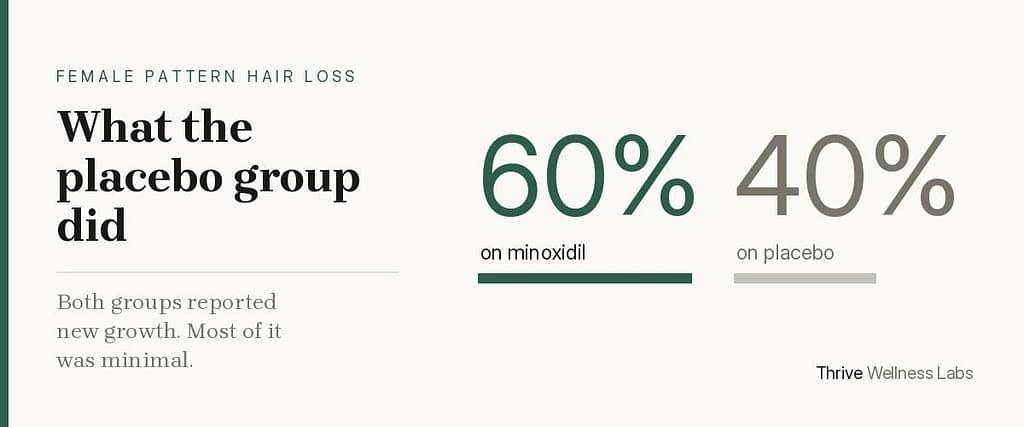
Here’s the number the marketing uses: in a placebo-controlled trial of 308 women, 60% of those using minoxidil reported new hair growth.
Here’s the number it leaves out: 40% of the women on placebo reported the same thing.19
That’s not a reason to dismiss the treatment — it worked, and the difference was real. But most growth in both groups was graded minimal. Moderate growth was reported by 20% on minoxidil and 7% on placebo. Not one woman in either group was rated as having dense growth.
A separate trial found the same pattern: 60% improving on minoxidil against 46% on placebo.20 High placebo response isn’t a quirk of one study.
So what should you actually expect?
For a progressive condition, maintaining your current density over 12 months is considered a successful outcome. Photographs that look the same in a year are a good result, not a failure.
Some regrowth is a genuine possibility on top of that. Returning to the hair you had at 25 is not.
On timing: hair counts were measured at 12 weeks and appearance at 24. Give it six months before you judge, a year before you conclude much.
On stopping: treatment maintains rather than cures. The drug doesn’t change what’s causing the miniaturization. Worth being honest that this hasn’t been properly tested — no trial has followed women after discontinuation. The one withdrawal study was in ten men, decades ago, and most of the gained hair was lost.21
One last thing about averages. In one trial the variation between individuals was larger than the average effect itself. Trial percentages describe groups. They don’t predict you.
What doesn’t work, or barely does
A distinction first: no evidence something works is not the same as evidence it doesn’t work. Most of what follows is untested rather than disproven.
Biotin. The only controlled trial in women lasted four weeks, enrolled women with diffuse hair loss rather than pattern hair loss, and found no difference against placebo.22 No trial has tested biotin alone in female pattern hair loss. We’ve looked at the biotin evidence in more depth here.
Collagen. No trial has tested collagen on its own for this condition. The positive results you’ll see cited come from supplements containing a dozen other ingredients.
Rosemary oil. The study behind every viral post compared rosemary oil against 2% minoxidil in 100 people over six months. Both groups improved, and there was no difference between them.23
That sounds impressive until you notice there was no placebo group. Two treatments improving equally can’t tell you whether either beat doing nothing — and this trial wasn’t designed to test equivalence, was never repeated, and used the weaker 2% concentration. Our rosemary oil review goes through the study in detail.
Saw palmetto. The main trial pooled men and women together, with only four to six women per group, and was run by people affiliated with the manufacturer.
Ketoconazole shampoo. There is one trial in women with pattern hair loss — but it tested a leave-on microemulsion, not a rinse-off shampoo.24 Medicated shampoo is a reasonable product if you have dandruff or seborrheic dermatitis. Different problem.
If you’re weighing up serums specifically, our ingredient comparison of premium scalp serums found the cheapest product in the group contained more of the active complexes than the most expensive.
How we put this together
Treatments were ranked before products were chosen. We reviewed the evidence for each female pattern hair loss treatment first, sorted it by strength, and only then looked for products. Nothing here was selected because of what it pays.
Sources are trials, systematic reviews and dermatology databases — not other blogs. They’re listed below. Where a claim rests on one small study, we say so. Where the evidence is contested, we say that rather than picking the convenient side.
We haven’t tested anything ourselves. This is an evidence review, not a personal trial, and we’re not clinicians. Nothing here is medical advice.
Three limitations worth knowing. Several cited trials used 3% minoxidil, which isn’t sold at US retail. Most prevalence figures for this condition come from studies published between 2001 and 2005. And treatment-level evidence doesn’t validate every individual product — a minoxidil trial supports minoxidil, not one brand’s listing.
On money. We earn a commission if you buy through our links. The rate did not influence the order of recommendations, and the treatment we recommend first is among the lowest-paying products on this page.
No brand paid for placement, supplied products, or reviewed this article.
Evidence reviewed: August 2026. Next review: February 2027.
Common questions
How do you tell the difference between shedding and hair loss?
Shedding is hair coming out from a scalp that still looks full. Pattern loss is hair regrowing finer until there’s visibly less of it. They can happen together, and only a clinician can tell you which you have.
What is the most effective female pattern hair loss treatment?
Topical minoxidil, on the evidence available. It’s the only option tested in thousands of women, and it’s also among the cheapest. Prescription options exist for women who don’t respond after six months.
Can female pattern hair loss be reversed?
Partly, sometimes. The realistic goal is stopping further loss, with modest regrowth on top for some women.
What deficiency causes female pattern hair loss?
None that’s established. Low iron and thyroid problems cause shedding, a different process, and both are worth ruling out. But when iron was tested as a treatment in women with pattern loss, it added nothing.
Do supplements help?
The evidence is weak. Biotin has no supporting trial in this condition, collagen has never been tested on its own, and the leading branded supplement’s trials were all funded by its manufacturer.
What shampoo do dermatologists recommend?
There isn’t one with regrowth evidence behind it in women. The one trial tested a leave-on treatment, not a rinse-off shampoo.
Can stress cause it?
Stress can trigger a shedding episode. It doesn’t cause the underlying pattern process, though a shed can make existing thinning visible.
Is minoxidil safe around pets?
Not around cats. It’s severely toxic to them and can be fatal in tiny amounts. See the safety box above.
How long before I know if treatment is working?
Six months to judge, a year to conclude. Compare photographs, not memory.
References
- Carmona-Rodríguez M, et al. Frontal fibrosing alopecia: an observational single-center study of 306 cases. Life. 2023.
- DailyMed. Women’s Rogaine 5% minoxidil topical aerosol — prescribing label.
- Smorlesi C, et al. Topically applied minoxidil may cause fetal malformation: a case report. Birth Defects Res A Clin Mol Teratol. 2003;67:997–1001.
- Drugs and Lactation Database (LactMed). Minoxidil. National Institute of Child Health and Human Development. Revised May 2026.
- Werachattawatchai P, et al. Efficacy and safety of oral spironolactone for female pattern hair loss in premenopausal women. Int J Womens Dermatol. 2025;11(3):e227.
- Ablon G, Kogan S. A six-month, randomized, double-blind, placebo-controlled study evaluating a nutraceutical supplement for promoting hair growth. J Drugs Dermatol. 2018.
- Ablon G, Kogan S. A randomized, double-blind, placebo-controlled study of a nutraceutical supplement for thinning hair in perimenopausal women. J Drugs Dermatol. 2021.
- Rebora A, et al. Distinguishing androgenetic alopecia from chronic telogen effluvium. Arch Dermatol. 2005;141:1243–1245.
- Hirose A, et al. Investigation of exacerbating factors for postpartum hair loss. Int J Womens Dermatol. 2023;9:e084.
- Dinh QQ, Sinclair R. Female pattern hair loss: current treatment concepts. Clin Interv Aging. 2007;2:189–199.
- Triwongwaranat D, et al. Efficacy of oral iron supplementation in patients with female pattern hair loss and low serum ferritin. Siriraj Med J. 2023;75:759–762.
- van Zuuren EJ, Fedorowicz Z, Schoones J. Interventions for female pattern hair loss. Cochrane Database Syst Rev. 2016;(5):CD007628.
- Blume-Peytavi U, et al. Once-daily minoxidil foam 5% versus twice-daily minoxidil solution 2% in female pattern hair loss. J Drugs Dermatol. 2016;15(7):883–889.
- Lucky AW, et al. A randomized, placebo-controlled trial of 5% and 2% topical minoxidil solutions. J Am Acad Dermatol. 2004;50(4):541–553.
- Jimenez JJ, et al. Efficacy and safety of a low-level laser device in male and female pattern hair loss. Am J Clin Dermatol. 2014.
- Ramos PM, et al. Minoxidil 1 mg oral versus minoxidil 5% topical solution for female-pattern hair loss. J Am Acad Dermatol. 2020.
- Price VH, et al. Lack of efficacy of finasteride in postmenopausal women with androgenetic alopecia. J Am Acad Dermatol. 2000.
- Liu et al. Microneedle frequency adjunct to 2% minoxidil in female androgenetic alopecia: a randomized controlled trial. J Am Acad Dermatol. 2026.
- DeVillez RL, et al. Androgenetic alopecia in the female: treatment with 2% topical minoxidil solution. Arch Dermatol. 1994;130(3):303–307.
- Whiting DA, Jacobson C. Treatment of female androgenetic alopecia with minoxidil 2%. Int J Dermatol. 1992;31:800–804.
- Olsen EA, Weiner MS. Topical minoxidil in male pattern baldness: effects of discontinuation of treatment. J Am Acad Dermatol. 1987;17(1):97–101.
- Pawlowski A, Kostanecki W. Effect of biotin on hair roots and sebum excretion in women with diffuse alopecia. Pol Med J. 1966;5(2):447–452.
- Panahi Y, et al. Rosemary oil vs minoxidil 2% for the treatment of androgenetic alopecia. Skinmed. 2015;13(1):15–21.
- El-Garf A, Mohie M, Salah E. Trichogenic effect of topical ketoconazole versus minoxidil 2% in female pattern hair loss. Biomed Dermatol. 2019;3:8.
Medical Disclaimer: Thrive Wellness Labs provides health and wellness information for educational purposes only. It is not a substitute for professional medical advice, diagnosis, or treatment. Always seek the advice of your physician or other qualified health provider with any questions you may have regarding a medical condition, supplement, or treatment device.
FDA Disclosure: These statements have not been evaluated by the Food and Drug Administration. The products reviewed on this site are not intended to diagnose, treat, cure, or prevent any disease.